
IFIM School of Law offers a three-year LL.B. program, uniquely designed for graduates
seeking to transition into the legal profession. Open to candidates from any disciplinary
background, this program stands apart as one of the few professional pathways that
welcomes graduates across all fields, making it an exceptional opportunity for those looking
to redefine their career trajectory. The program is affiliated to the Karnataka State Law
University (KSLU).
At IFIM, legal education goes beyond the classroom. Through a carefully curated blend of
online and offline pedagogical approaches, students are immersed in a rich academic
environment that fosters a deep, nuanced understanding of law. Our teaching philosophy
places equal emphasis on theoretical rigour and practical application, ensuring that every
student receives a truly holistic educational experience.
...
The three-year LL.B. curriculum is purposefully structured by the Karnataka State Law
University to develop continuously employable, industry-ready legal professionals. Students
are not merely taught the law — they are trained to think, argue, and practise it. By the
culmination of the program, graduates are equipped to pursue distinguished careers across
a broad spectrum of legal domains, including the judiciary, corporate law, banking and
finance law, litigation, and academia, among others.
At IFIM School of Law, we do not just educate lawyers — we shape the legal leaders of
tomorrow.
Among the Top Leading Law Schools of Super Excellence in India , 𝗚𝗛𝗥𝗗𝗖 Law Schools 𝗦𝘂𝗿𝘃𝗲𝘆 𝟮𝟬𝟮𝟱
Among the Top Leading Law Schools of Super Excellence in karnataka , 𝗚𝗛𝗥𝗗𝗖 Law Schools 𝗦𝘂𝗿𝘃𝗲𝘆 𝟮𝟬𝟮𝟱
Among the Top Leading Law Schools of Super Excellence in Southern Region , 𝗚𝗛𝗥𝗗𝗖 Law Schools 𝗦𝘂𝗿𝘃𝗲𝘆 𝟮𝟬𝟮𝟱
Among the Top Leading Law Schools of Super Excellence in India , 𝗚𝗛𝗥𝗗𝗖 Law Schools 𝗦𝘂𝗿𝘃𝗲𝘆 𝟮𝟬𝟮𝟱
Among the Top Leading Law Schools of Super Excellence in karnataka , 𝗚𝗛𝗥𝗗𝗖 Law Schools 𝗦𝘂𝗿𝘃𝗲𝘆 𝟮𝟬𝟮𝟱
Among the Top Leading Law Schools of Super Excellence in Southern Region , 𝗚𝗛𝗥𝗗𝗖 Law Schools 𝗦𝘂𝗿𝘃𝗲𝘆 𝟮𝟬𝟮𝟱
Personality Enhancement program (PEP)
PEP is designed to guide students to identify personality shortcomings, deepen self-realization, and develop positive belief systems. Curriculum includes Life style and Life skill components.
Research Incubation (RI)
'Research Incubation' Program aims to equip students with critical thinking, problem-solving and research-oriented thinking skills which will enable them to thrive and innovate in the present fast-changing business environment.
Social Immersion program (SIP)
SIP combines on-ground learning with a social cause. Students work closely with NGO’s across India to promote Anti-Pollution Drive, Help Age India, CRY, Bachpan Bachao Andolan, Youth for Seva.
Industry Internship program (IIP)
IIP is a experiential project that provides opportunities for students with reputed brands that enables them to deep dive into the ground reality of business.
Corporate Mentoring (CM)
CM prepares the students for professional careers and the development of their workplace skills. It also helps the students to develop a vision and mission for their personal and career Growth.
Candidates must have completed 10th and 12th standard with a minimum of 50% marks from a recognised board.
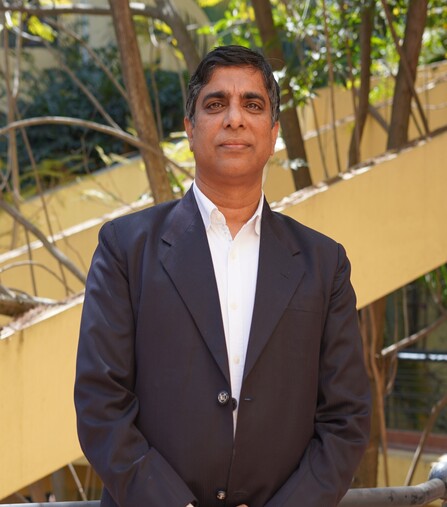

Prof. Arunkumar holds a Ph.D. in Economics from the Institute for Social and Economic Change (ISEC), Bengaluru, sponsored through an RBI doctoral fellowship. In addition to his M.Phil (Central University Pondicherry) and UGC-NET qualifications, he completed his Certificate course in Management from Asian Institute of Management, Manila and completed Certificate Course in MSME credit from Israel. He is also certified in Financial Risk Management by the Chartered Institute of Securities and Investment (CISI), London. In addition, he participated over 200 advanced training programs globally, focusing on finance, banking, policy, leadership and administration.
Prof. Arunkumar’s professional journey began as a faculty of Economics and Commerce, followed by roles as a Research Fellow and Deputy Director at the Centre for Budget and Policy Studies (CBPS), Bengaluru. His career in industry spans across senior leadership roles, including Assistant General Manager (AGM) – Economist at Small Industries Development Bank of India (SIDBI), and key executive positions such as Deputy General Manager and General Manager in the credit and risk management areas. Prof. Arunkumar later functioned as the Chief Risk Officer of a commercial bank in India and international banks abroad. He has also led cross-functional teams, supervised large-scale projects, and introduced policies and processes that enhanced operational efficiency.
In academics, experienced in managing undergraduate, postgraduate and research programs across University and Autonomous business school, with particular focus on enhancing skill-oriented curricula and experiential learning. During this period, developed programs that integrate both theoretical knowledge and practical applications, ensuring students are well-prepared for the business world. He has been teaching subjects related to banking, finance, risk management, development policy and economics. While in Industry, Prof. Arunkumar had been a regular visiting faculty in various training academies and centres of banking and finance.
Prof. Arunkumar’s research covers areas such as access to credit, technology, policy for small enterprises, microfinance, development banking, sustainable finance including sustainable development, and digital financial inclusion. His contributions to academia are reflected in his working papers, journal articles, book chapters, and books. He is also a regular commentator on financial and economic matters in mainstream newspapers.
The recent co-edited book titled: “Institutions and Public Policy for India’s Sustainable Development” was released in January 2025, which was published by Routledge/Taylor and Francis, London.
LinkedIn Profile: https://www.linkedin.com/in/a-v-arunkumar-8b424613/
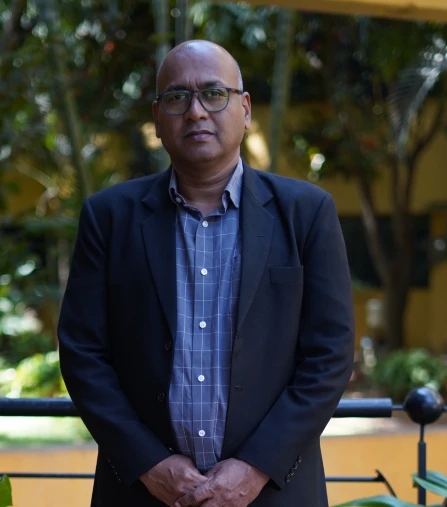
Dr. Aswini Patro has twenty-two years of experience in International Consulting, Litigation
Practice and Academics. Prof. Patro worked as a faculty at KIIT School of Law and held
multiple responsibilities like Head of Department of International Law and Faculty Coordinator
for Post Graduate program. Formerly, Director at a Chicago based Legal Services Firm
involved in management of Indian operations and managed legal projects like contract review
and management along with litigation management.
Prof. Patro also worked with Ministry of Environment, Republic of Macedonia (during 2006-
2007) on issues related to international trade law. He represented Brunel University School of
International Law team in “Regulating the European Market”; a conference conducted jointly
by Clifford Chance and Institute of European and Comparative Law, the University of Oxford.
He loves interacting with students and likes to be involved with problem solving activities for
effective learning. He adapts Socratic and Case Study methods in teaching. His interest lies in
Law of Contract, Trade Law and Commercial Arbitration.
Trade Dispute Mechanism, International Commercial Arbitration and Regulation of emerging Technologies
Core Course: ADR, Trade Law, Private International Law and Commercial Arbitration
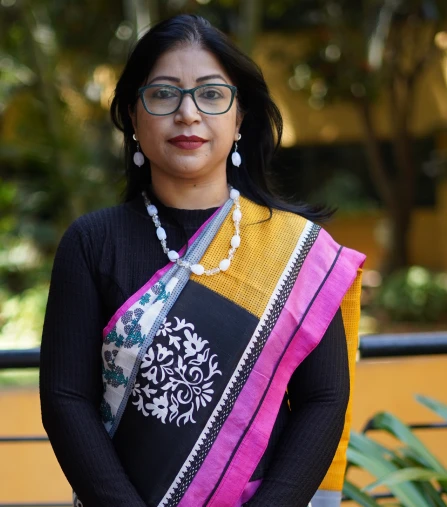
Dr. Shagufta Anjum is an accomplished academician and researcher with a strong focus on contemporary legal issues, particularly in the areas of labour law, gender justice, human rights, and emerging intersections between law and technology. Her scholarly contributions reflect a sustained engagement with evolving legal frameworks in response to socio-economic transformations.
Her research portfolio includes significant publications in reputed journals and edited volumes. Notably, her work on gig economy and platform employment has been published in Reform India 2025: Journal of 2025 Reforms by Law Hunt Solutions India Pvt. Ltd. (2026). She has also authored a Scopus-indexed publication titled “The Silent Victims of Compassion” in TPM – Testing, Psychometrics, Methodology in Applied Psychology (2025), which undertakes a comparative analysis of surrogacy laws across jurisdictions. Her earlier contributions include book chapters on compensatory jurisprudence and surrogacy rights published by Walnut Publications and Bharti Publications, along with articles addressing assisted reproduction laws and migrant labour issues, including a publication with National Law School of India University.
Dr. Shagufta has actively participated in national and international academic platforms. She has presented research papers on themes such as gig economy, marginalised communities, and access to justice at reputed conferences and seminars. Her academic engagement extends to leadership roles, including serving as a Technical Session Chair at the International Conference on Global Legal Challenges (GLC-2025) hosted by Dayananda Sagar University in collaboration with Staffordshire University.
In addition to her research, she has contributed as a resource person, delivering expert lectures on constitutional values, workplace safety for women, and evolving interpretations of life and liberty. Her commitment to academic development is reflected in her participation in multiple Faculty Development programs, including those organized by National Foundation for Entrepreneurship Development, Amity University, and workshops conducted by Banaras Hindu University.
Dr. Shagufta has also engaged with contemporary technological advancements through participation in initiatives such as the AI literacy campaign conducted by the National Commission for Women at Christ University, reflecting her interest in integrating technology with legal education and social justice.
Overall, her academic journey demonstrates a consistent commitment to research excellence, interdisciplinary inquiry, and socially relevant legal scholarship, positioning her as a dynamic contributor to legal academia.
Research Methodology, Women and Child Laws, Business Laws, Advocacy Skill (Professional training), Family laws, Interpretation of Statutes and Criminal Laws.
Core Course: Law
Elective Course: Research Incubation, Law and Political Society, Cyber Laws.
Published at the Reform India 2025: Journal of 2025 Reforms Vol I, Law Hunt Solutions India Pvt. Ltd. https://lawhunts.com/news-letter/#flipbook-df_36952/69/
Published in the Journal – TPM – Testing, Psychometrics, Methodology in Applied Psychology. https://tpmap.org/submission/index.php/tpm/article/view/3149
International Conference on Global Legal Challenges in the Transforming Society (GLC-2025) Technical Session – Chair Nov 2025 – Nov 2025 Dayananda Sagar School of Law, Dayananda University in collaboration with Staffordshire University, United Kingdom on 22nd Nov 2025.
Angarika Borah is an academic specializing in Natural Resources Law, with research focusing on environmental law, dimensions of human rights, and Sustainable Development Goals (SDGs). Her work critically examines the intersection of environmental governance, human rights frameworks, and sustainable development policies.
She completed her LL.M. from Tamil Nadu National Law University and began her academic career in Chennai. She is currently serving as an Assistant Professor at IFIM Law School, Bengaluru, with teaching and research experience in core areas of law. She has also completed certification courses in Constitutional Law, Criminal Law, and Commercial Contract Drafting.
Her research has been published in reputed journals and edited volumes, including Shilpkar Law Review, International Journal of Advanced Legal Research, Indian Journal of Law and Legal Research, and International Journal of Law Management and Humanities.
Angarika Borah has actively contributed to academic and co-curricular activities, participating in numerous national and international conferences. She has received recognition for her scholarly contributions, including awards for best paper presentations and research excellence. She is also invited as a judge in moot court competitions, ADR mediation competitions, client counselling competitions and as speaker in workshops.
She actively contributes to academic leadership through curriculum development, research engagement, and the organization of academic events, while playing a key role in various institutional committees.
In the classroom, she teaches Environmental Law, Constitutional Law, and White-Collar Crime, with a focus on experiential learning through case analysis, research-based teaching, and interactive pedagogy. Her teaching approach emphasizes analytical thinking and practical legal understanding.
Core Course: Environmental Law, Constitutional Law
Elective Course: White Collar Crime